
What is JAXA's MMX mission? Japan's trip to Mars's moon Phobos
MMX is Japan's mission to land on Mars's moon Phobos and bring a sample to Earth in 2031. It launches at 4:41 a.m. JST on 20 October 2026.
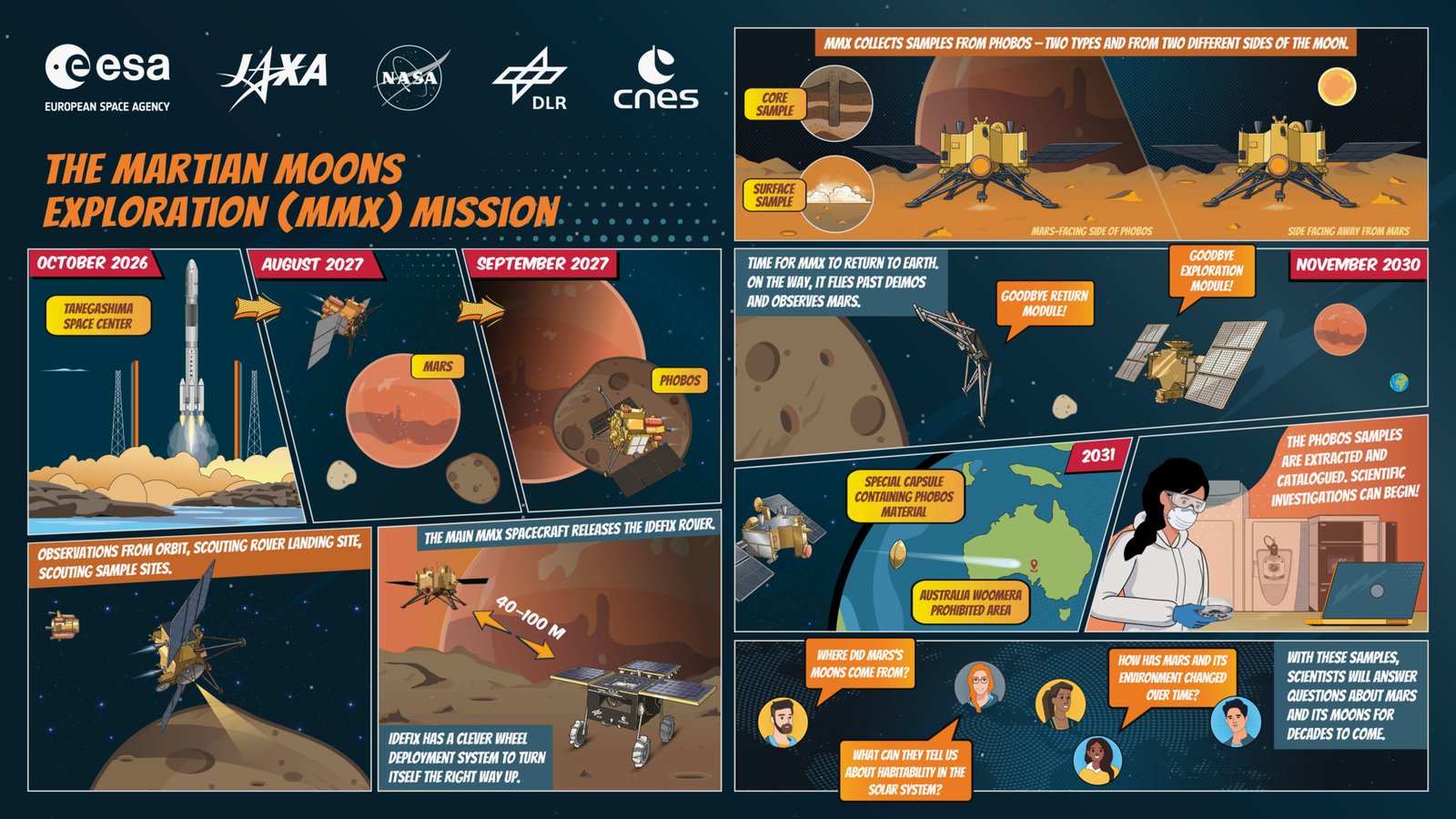
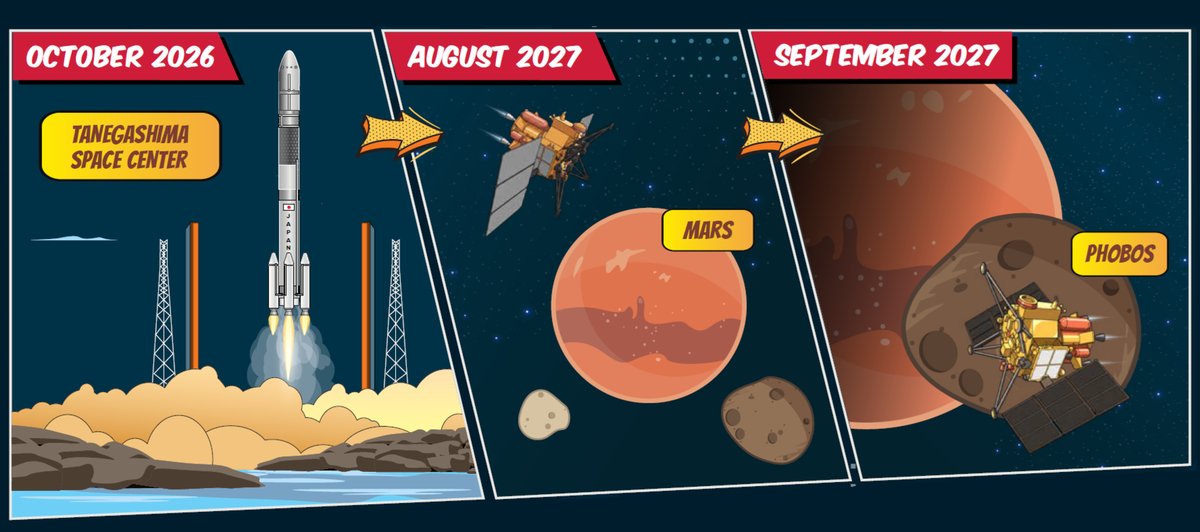
Martian Moons eXploration (MMX) is a mission by the Japan Aerospace Exploration Agency (JAXA) to Phobos, the larger of Mars's two moons. It will study Phobos from orbit, put a small rover on its surface, land to collect at least 10 grams of material, and bring that sample to Earth in 2031. It is set to launch on an H3 rocket from Tanegashima, Japan, at 4:41 a.m. Japan Standard Time (JST) on 20 October 2026.
Status as of 9:30 p.m. JST on 19 October, before launch. At about 8 p.m. JST, JAXA's MMX team posted on X that the rocket, with MMX on board, had arrived at the launch pad and that the mission was "just a few hours from liftoff". We will update this page after the launch.
When and how is MMX launching?
- Time: 4:41:03 a.m. JST on 20 October 2026.
- Backup dates: 21 October to 9 November 2026. JAXA says the launch time changes from day to day, because the rocket has to send MMX onto a path to Mars.
- Rocket: H3 Flight No. 10, in its most powerful version, called H3-24L. It has two main engines, four solid rocket boosters (strap-on boosters that burn solid fuel and drop away early) and a long fairing, the nose cone that protects the spacecraft on the way up. JAXA's press kit says it is 63 m tall and weighs 574 tonnes without its payload.
- Site: Yoshinobu Launch Complex, Tanegashima Space Center, Japan.
According to JAXA's launch plan, the boosters drop off about 2 minutes after liftoff and the fairing comes off at about 3 minutes 17 seconds. The second stage fires twice, restarting its engine in space. MMX then separates onto its path to Mars about 1 hour 11 minutes after launch, around 5:52 a.m. JST if it lifts off on time.
JAXA says it will stream the launch on its YouTube channel with English interpretation, starting at 3:45 a.m. JST.
Why go to Phobos?
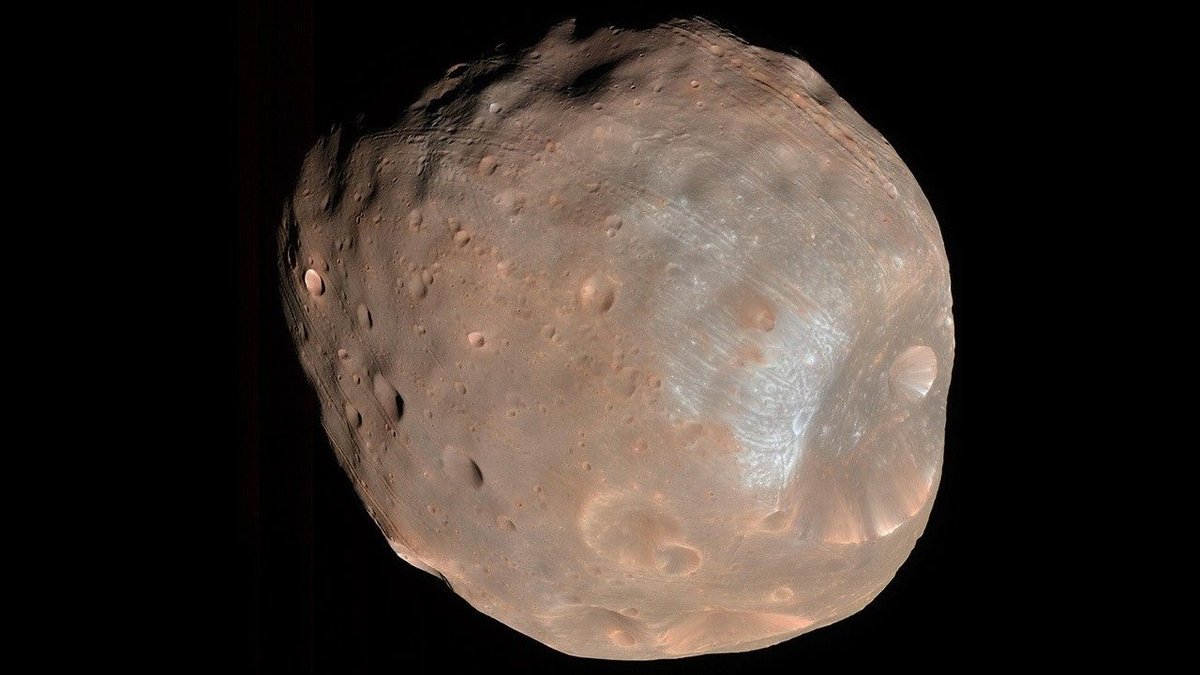
Nobody knows for sure how Mars got its two moons, Phobos and Deimos. JAXA describes two main ideas. They could be asteroids that Mars's gravity captured. Or they could have formed from debris thrown into orbit when something huge hit Mars. Samples studied in labs on Earth should help settle it, says ESA.
Phobos may also hold pieces of Mars itself. JAXA says it is thought to be covered in material blasted off the Martian surface by impacts, which could record how Mars's environment changed over time. The mission also aims to learn how water and organic material moved around the early Solar System.
There is a practical reason too. JAXA says Mars's strong gravity makes landing there and bringing samples back very difficult. Phobos is small, so JAXA can reuse the methods it used to collect samples from asteroids on its Hayabusa and Hayabusa2 missions.
What is on the MMX spacecraft?
The spacecraft was built by Mitsubishi Electric and weighs about 4,480 kg at launch, according to JAXA. It has three parts:
- Propulsion module: for the trip out. JAXA's diagram shows only the other two modules after MMX goes into orbit around Mars.
- Exploration module: for the work at Phobos.
- Return module: the only part that flies home. It brings back the sample in a capsule.
JAXA says MMX carries 13 instruments. They include two cameras, a laser rangefinder, a dust monitor and several spectrometers. A spectrometer works out what something is made of from the light or particles it gives off. One, the Mars-moon Exploration with Gamma rays and Neutrons (MEGANE) spectrometer, comes from the National Aeronautics and Space Administration (NASA). Another, the MMX InfraRed Spectrometer (MIRS), comes from France. Two samplers and the capsule that brings the sample home complete the science set. Two of the 13 are technology tests: a radiation monitor and 8K and 4K ultra-high-definition cameras built with Japan's public broadcaster, the Japan Broadcasting Corporation (NHK).
One of the 13 is Idefix, a 25 kg rover built by France's space agency, the Centre National d'Études Spatiales (CNES), and the German Aerospace Center (DLR). ESA says Phobos's gravity is so weak that Idefix will weigh the equivalent of just 15 grams there.
ESA counts the instruments differently. It lists 11 science instruments, seven on the main spacecraft and four on the rover. Both counts describe the same hardware.
What is the MMX mission timeline?
Here is the plan, from JAXA's mission page and ESA's infographics (shown on this page):
- 2026: launch, then about a year's cruise to Mars.
- 2027: arrival. ESA says MMX should enter Mars orbit in August 2027 and orbit Phobos from September 2027, in what's called a "quasi-satellite orbit". In this orbit the spacecraft travels around Mars alongside Phobos, so it seems to circle the moon.
- Early 2029: Idefix is released to land on Phobos first and check the surface, according to ESA.
- 2030: the main spacecraft lands to collect samples. JAXA says it will make two soft landings, spending about 2 to 3 hours on the surface each time. One sampler digs about 2 cm into the ground. NASA's pneumatic sampler (P-SMP) uses a puff of nitrogen gas to blow loose material into a container.
- 2030: MMX leaves the Mars system, flying past Deimos. ESA's infographic dates the departure to November 2030.
- 2031: the capsule lands in Australia, in the Woomera Prohibited Area according to ESA. The sample then goes to Japan.
JAXA's own schedule gives the whole stay at Phobos as "2027 to 2030" rather than exact landing dates. Treat the 2029 and 2030 dates as current plans that could change.
What would make MMX a first?
- First sample from the Mars system. JAXA calls MMX the world's first sample return mission from the Martian sphere.
- First landing on Phobos. JAXA says Idefix will be the first to land there.
- First orbit around Phobos, and first sample from another planet's moon. ESA says MMX will be the first spacecraft to orbit Phobos and the first to collect samples from a moon other than our own.
To be precise: MMX would not be the first landing on another planet's moon. ESA's Huygens probe landed on Saturn's moon Titan on 14 January 2005. MMX's firsts are about Phobos and about bringing a sample home.
Who is working on MMX?
JAXA leads the mission with NASA, CNES, DLR and ESA. NASA supplies the MEGANE spectrometer and the P-SMP sampler. CNES supplies the MIRS spectrometer, and CNES and DLR jointly built Idefix. ESA is also a partner. It says the samples are planned to be made available to European scientists. JAXA calls MMX the largest international lunar and planetary exploration mission Japan has ever led.
MMX is a robotic sample mission, and it is not the only Mars plan in the works. SpaceX lists Starship cargo flights to Mars "no earlier than 2028". Read more in What is Starship?, see how its test flights have gone in Every Starship flight so far, or look up launch words in our Starship glossary.
Sources
Free newsletter
Get the Starship briefing.
Every Saturday, plus alerts when something big happens. Unsubscribe any time. Privacy