
SpaceX Q3 2026 earnings explained: where did the money come from?
SpaceX made $14.6 billion in revenue in Q3 2026, up 161%, and its AI business brought in more than Starlink for the first time. It also spent $19.6 billion in the quarter.
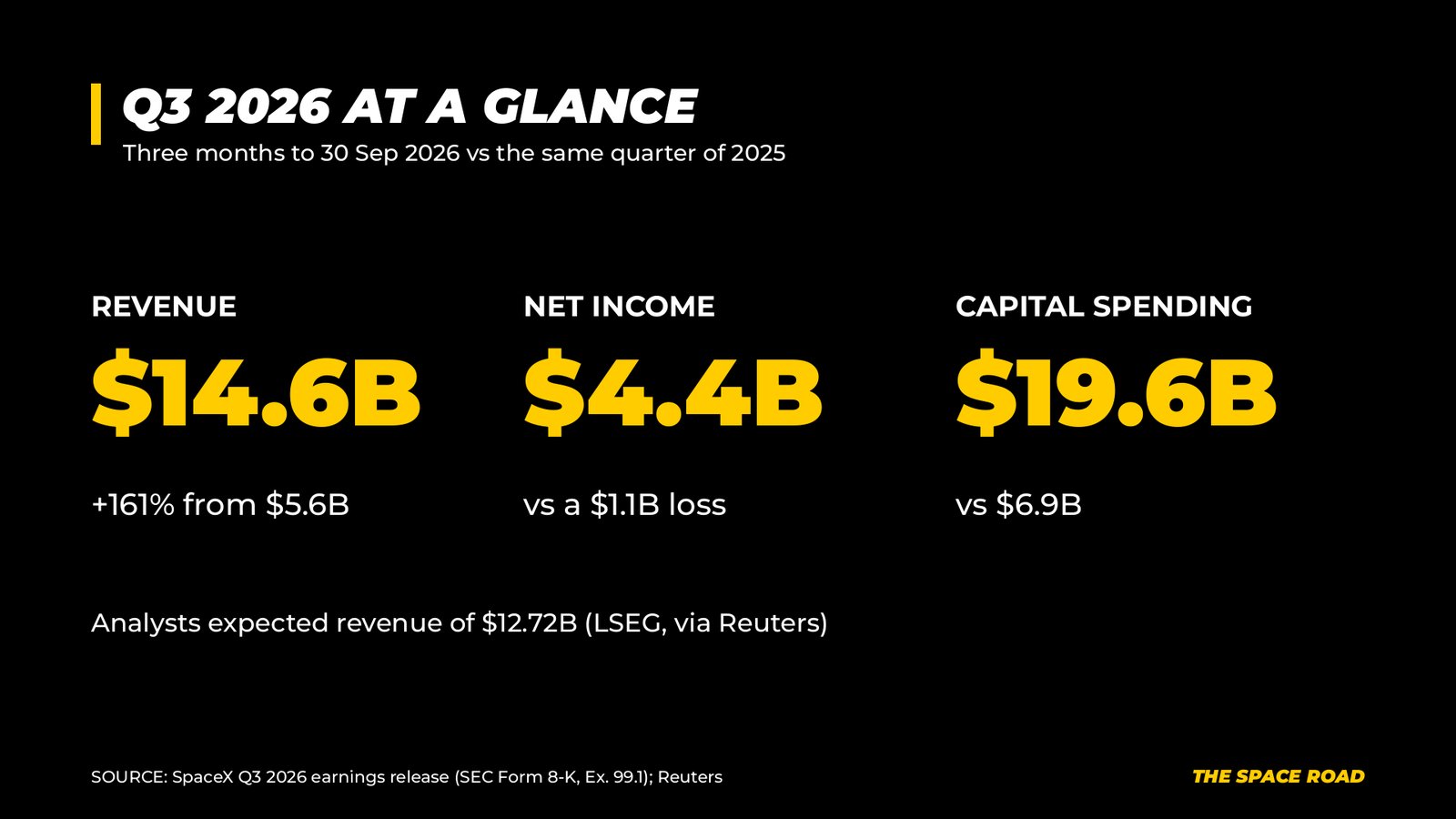
SpaceX's revenue was $14.6 billion in the third quarter of 2026 (July to September), up 161% from $5.6 billion a year earlier. For the first time, its artificial intelligence (AI) business, now called Super Intelligence, brought in more than Starlink: $7.56 billion against $5.25 billion. The company made a net profit of $4.4 billion, but it also spent $19.6 billion building data centres, rockets and satellites, more than it earned in revenue.
The figures come from SpaceX's Q3 2026 earnings release, filed with the US Securities and Exchange Commission (SEC) on 20 October 2026. SpaceX discussed them on its earnings call the same day at 3:30 p.m. CDT. Quotes below are from the call transcript published by The Motley Fool, and from Reuters. This is not investment advice. It is a guide to reading the numbers.
How much money did SpaceX make in Q3 2026?
Here are the three headline numbers, for the three months to 30 September 2026:
- Revenue: $14.6 billion, up 161% from $5.6 billion in the same quarter of 2025. Analysts expected about $12.72 billion, according to London Stock Exchange Group (LSEG) data cited by Reuters.
- Net income: $4.4 billion. A year earlier, SpaceX lost $1.1 billion.
- Capital spending: $19.6 billion, up from $6.9 billion. Capital spending (capex) is money spent on long-lasting things like data centres, factories, launch pads and satellites.
The profit needs one caveat. Operating profit, what the businesses themselves earned, was $2.8 billion. The rest of the $4.4 billion came from interest on SpaceX's cash, other gains and a tax benefit. So "$4.4 billion profit" overstates what the rockets, satellites and AI business made on their own.
What are SpaceX's three businesses?
SpaceX now reports three segments:
- Space: Falcon 9, Dragon, Starship and launches for customers.
- Connectivity: Starlink, SpaceX's satellite internet service.
- Super Intelligence: the segment SpaceX reported as "AI" until this quarter. It includes the Grok AI models, the X social network, the AI coding company Cursor and a large business renting out computing power in data centres.
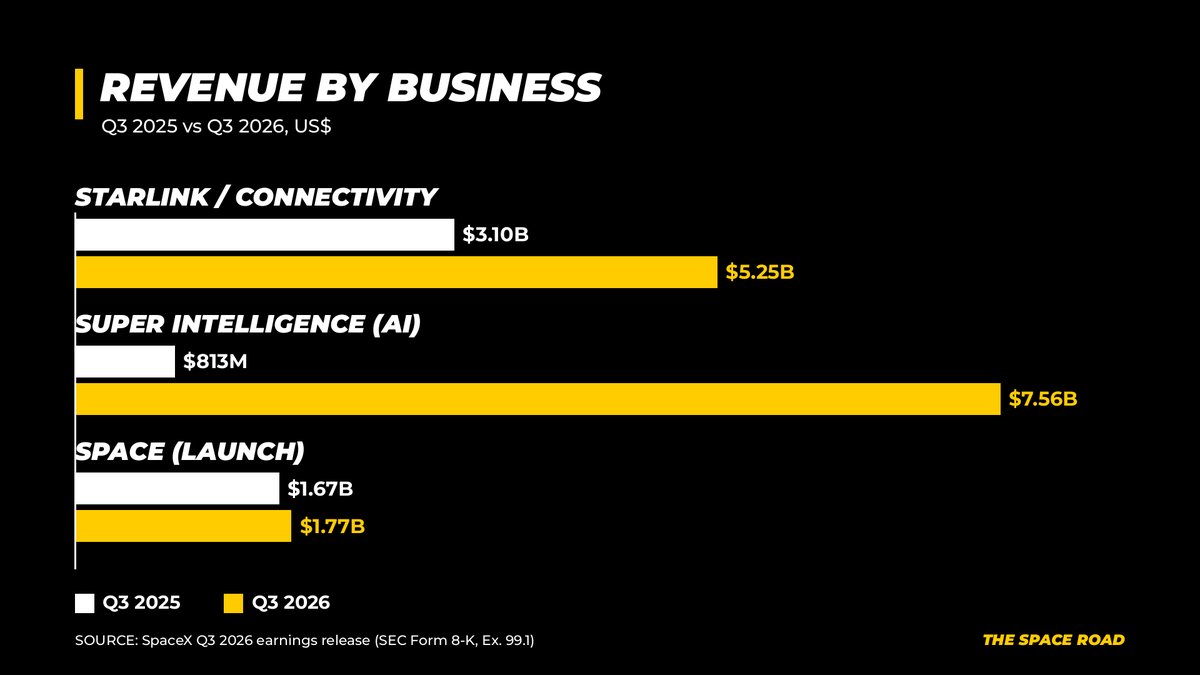
The growth was very uneven:
- Super Intelligence revenue went from $813 million to $7.56 billion, more than nine times bigger in a year.
- Starlink revenue rose 69%, to $5.25 billion.
- Space revenue rose only 6%, to $1.77 billion.
Which SpaceX business makes the most profit?
Starlink. Revenue only shows what comes in. Operating profit shows what each business keeps after its running costs.
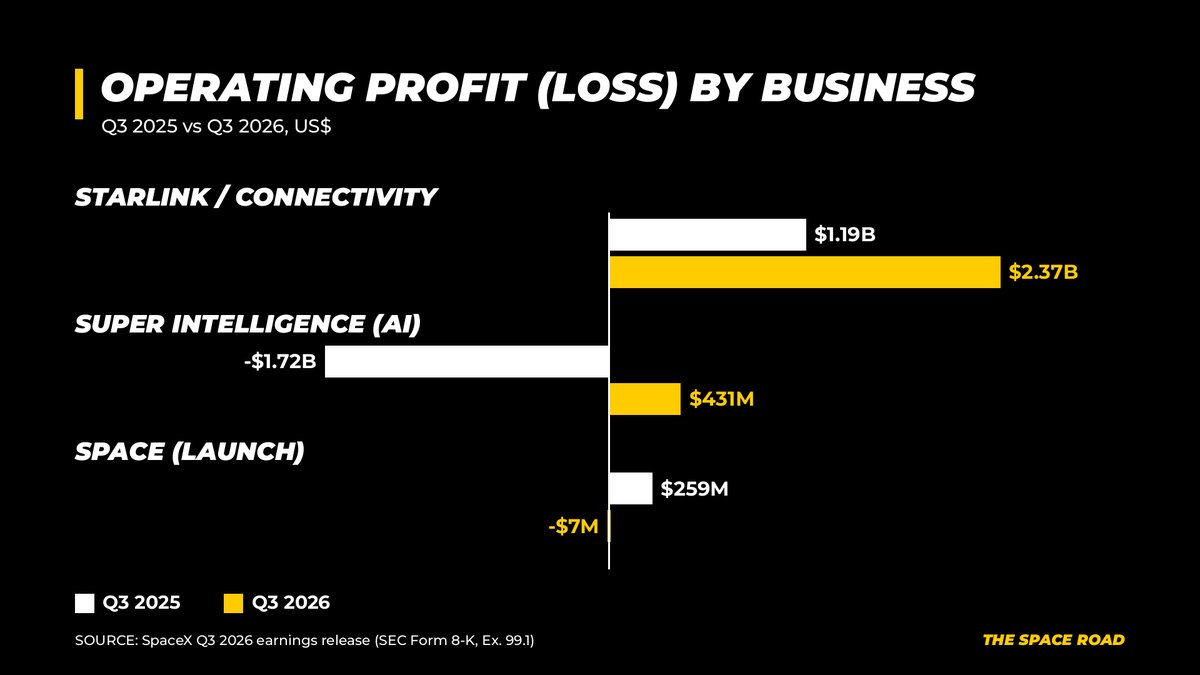
- Starlink made $2.37 billion of operating profit, about double the $1.19 billion of a year earlier.
- Super Intelligence made $431 million. A year earlier it lost $1.72 billion, and in the April to June quarter it lost about $1.26 billion. It is the first of these quarters in which the segment made a profit. The $431 million is after $1.2 billion of share-based pay (staff paid in stock) linked to the Cursor deal.
- Space roughly broke even, with a loss of $7 million, against a $259 million profit a year earlier and a $542 million loss in the June quarter.
The reason the launch business isn't making money is Starship. Research and development (R&D) spending in the space segment was $1.23 billion in the quarter, up from $849 million a year earlier. SpaceX does not report a separate cost for Starship. But it says space costs rose "as we continued to accelerate R&D investments in our Starship program."
How many Starlink subscribers does SpaceX have?
Starlink had 13.6 million consumer subscribers on 30 September 2026. That is up from 12.0 million at the end of June and 7.2 million a year earlier. Analysts expected about 12.2 million, according to Reuters.
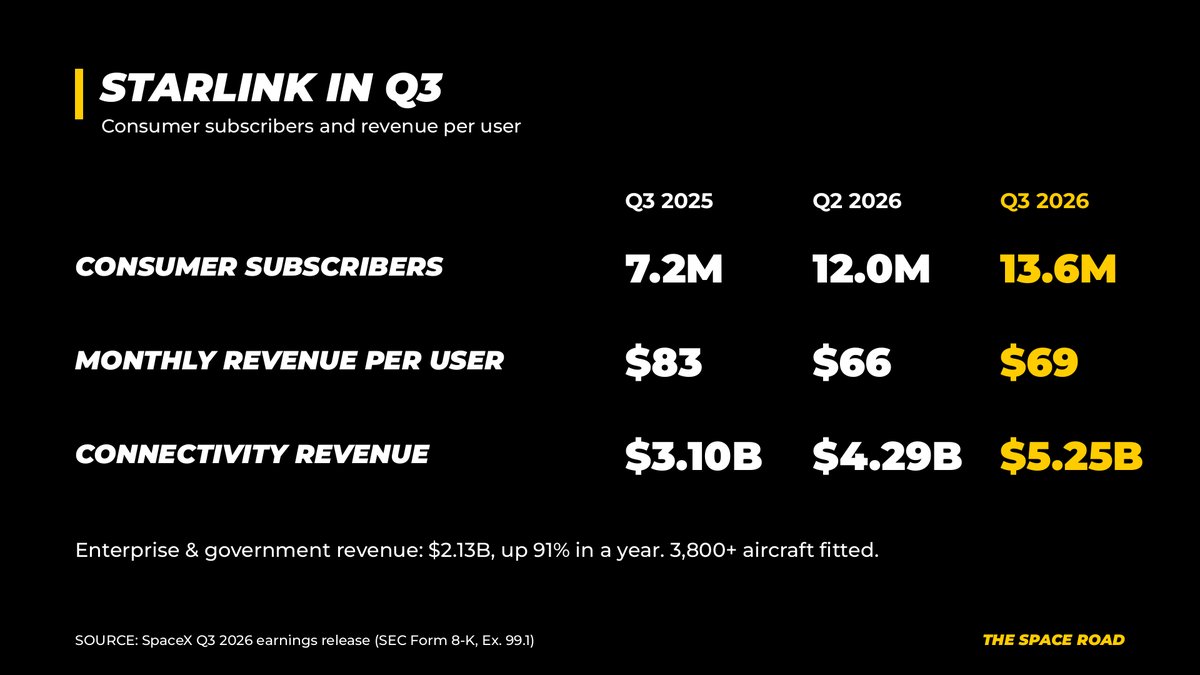
The number to watch is average revenue per user (ARPU), what the typical consumer pays each month. It was $69, down from $83 a year earlier. That fits a service selling into more countries on cheaper plans: more people, each paying less. ARPU did rise 5% from June's $66, which SpaceX puts down to a favourable mix of customers. One quarter doesn't make a trend.
The faster-growing side is business and government customers, such as airlines, ships and Starshield, SpaceX's work for the US government. That revenue was $2.13 billion, up 91% in a year. More than 3,800 aircraft now carry Starlink, and SpaceX President Gwynne Shotwell said on the call that about 12,000 planes are under contract.
Starship is part of the Starlink story too. SpaceX says Flight 14, its first orbital Starship flight, carried 26 Starlink V3 (third-generation) satellites. It says they add about 10 times the downlink capacity (the internet speed sent down to users) of a Falcon 9 Starlink launch. Here is every Starship flight so far.
How is SpaceX's launch business doing?
SpaceX launched 35 times in the quarter, down from 44 a year earlier. Only 12 of those launches were for paying customers. The other 23 were SpaceX's own, mostly Starlink. An internal launch brings in no launch revenue. It pays off later, through Starlink and other services.
The order book is still growing. SpaceX says it signed three more crew missions for the National Aeronautics and Space Administration (NASA) to the International Space Station, 18 National Security Space Launch missions for the US military, three Starfall missions (Starfall is SpaceX's capsule for experiments in microgravity, or near-weightlessness) and a contract to land a payload on the Moon with Starship. Chief Financial Officer (CFO) Bret Johnsen said total backlog, revenue signed but not yet earned, was $63 billion at 30 September. About $42 billion of it is expected within a year.
What did Elon say about Starship Flight 15?
Elon Musk said on the call that Flight 15 is expected "next month", and that SpaceX will "attempt to catch both the booster and the ship." If that works, he said, it will be "the first time that an orbital launch vehicle has been fully recovered." "Success is not guaranteed on these first flights," he said, "but I'd say it's more likely than not that this succeeds next flight."
Gwynne Shotwell said SpaceX expects the Federal Aviation Administration (FAA) licence for Flight 15 to include a return to the launch site and a tower catch for both stages. SpaceX has not yet announced a launch date. Our Flight 15 article tracks what still has to happen first.
Why does this matter for the money? A rocket that can be caught and flown again is far cheaper per launch than one that is thrown away. That is the whole bet behind Starship. Terms like booster catch and return to launch site are explained in our Starship glossary.
Where does SpaceX's AI revenue come from?
Most of it is not from Grok. Reuters reports that most Super Intelligence revenue came from renting out computing power to other AI companies, such as Anthropic and Google. In our view, that makes the segment look more like a cloud computing company than an AI lab today.
Part of the jump came from buying Cursor. SpaceX completed the deal on 14 August 2026, at an implied value of $60 billion. From then until 30 September, Cursor added $608 million of revenue. The deal also brings a cost: the $1.2 billion of stock pay this quarter, with more to come as Cursor staff's shares vest over time.
Bret Johnsen said that at current prices, new computing capacity is paying for itself in "less than a year". That holds only while demand and prices stay high.
How much is SpaceX spending, and where does the cash come from?
In every quarter in the chart below, SpaceX spent more on building than it brought in as revenue. Of the $19.6 billion of capex in Q3, $16.4 billion went to the AI business.
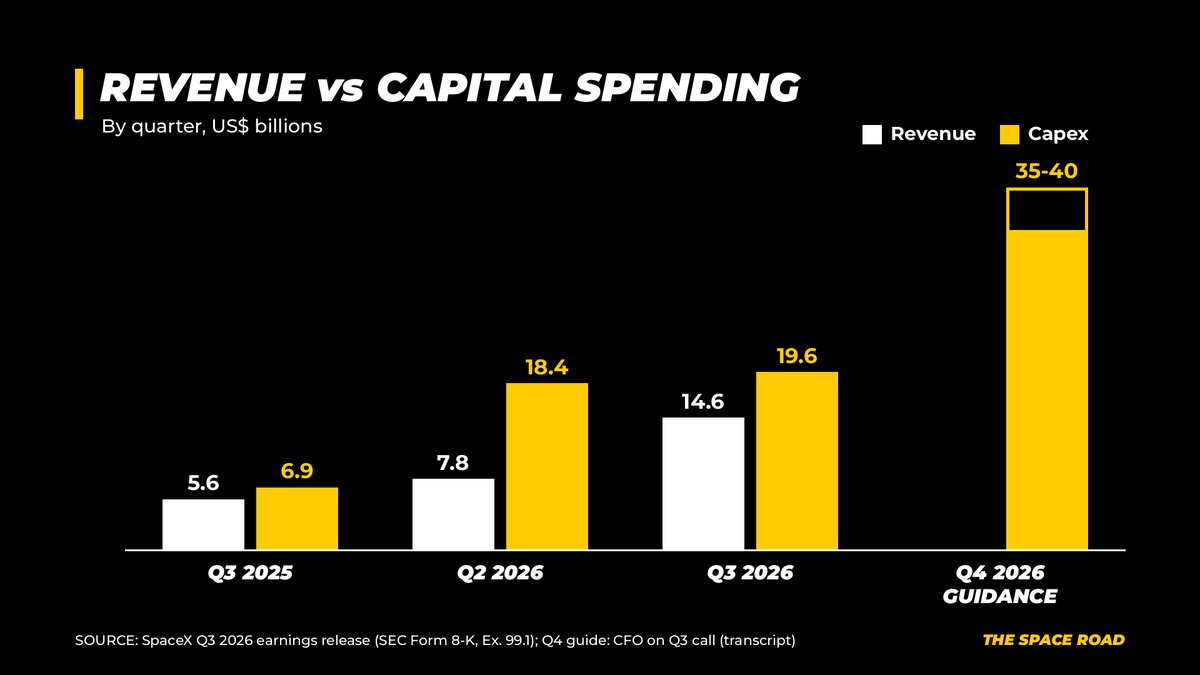
And it is speeding up. For October to December, Bret Johnsen expects capex of $35 billion to $40 billion, up to about double the Q3 figure.
The cash flow statement shows how SpaceX pays for it. In the first nine months of 2026:
- The business itself brought in $13.1 billion in cash from operations.
- It spent $48.1 billion on capex, a gap of about $35 billion.
- The gap was filled by its initial public offering (IPO), which raised $85.7 billion after costs, and by borrowing. Debt and finance leases reached $38.8 billion at 30 September, up from $22.9 billion at the end of 2025.
SpaceX ended September with $89.9 billion in cash and marketable securities (short-term investments it can quickly sell). It is not short of money today. The question is how long this pace of spending can last before profits from AI and Starlink catch up.
What does SpaceX expect next?
On the call, SpaceX gave these forecasts and targets:
- Revenue of $33 billion to $37 billion for January to March 2027, the CFO said. That is more than double Q3.
- $100 billion of annual recurring revenue (ARR) by December. ARR here means December's revenue times 12.
- Elon's own aim: ARR by the end of 2027 "somewhere between $500 billion and $1 trillion". He added, "I don't want to give Bret a heart attack." Treat this as Elon's ambition, not company guidance.
Elon summed up the quarter this way: "We are in an inflection moment for SpaceX across launch, connectivity and Super Intelligence."
Will SpaceX merge with Tesla?
Nothing is agreed. Asked about a merger with Tesla, Elon said he thinks it would be "a good idea, but it's really up to the special committees of both companies." He also warned against assuming a merger is "a certainty". According to Reuters, SpaceX shares rose about 8% in after-hours trading after the comment.
What should you watch next quarter?
Three things, in our view:
- Starlink ARPU. Does revenue per user keep rising, or was June to September a one-off?
- AI profit vs AI spending. Super Intelligence made $431 million of operating profit while taking $16.4 billion of capex. That gap has to close.
- Flight 15. If SpaceX catches both the booster and the ship, Starship moves a big step closer to cheap, reusable launches, the base for Starlink V3 and everything after it.
Starlink is the steady engine. The launch business is roughly breaking even while it pays for Starship. And the AI business is now the biggest, fastest-growing and most expensive part of SpaceX.
Sources
- SpaceX: Q3 2026 earnings release, SEC Form 8-K, Exhibit 99.1 (20 Oct 2026)
- SpaceX Investor Relations: Q3 2026 earnings event (webcast and replay)
- The Motley Fool: SpaceX (SPCX) Q3 2026 earnings call transcript
- Reuters, via NBC News: SpaceX quarterly revenue jumps on data-centre business (20 Oct 2026)
- Reuters, via Investing.com: SpaceX revenue beats estimates as AI business surges; Elon on a Tesla merger (20 Oct 2026)
Free newsletter
Get the Starship briefing.
Every Saturday, plus alerts when something big happens. Unsubscribe any time. Privacy