
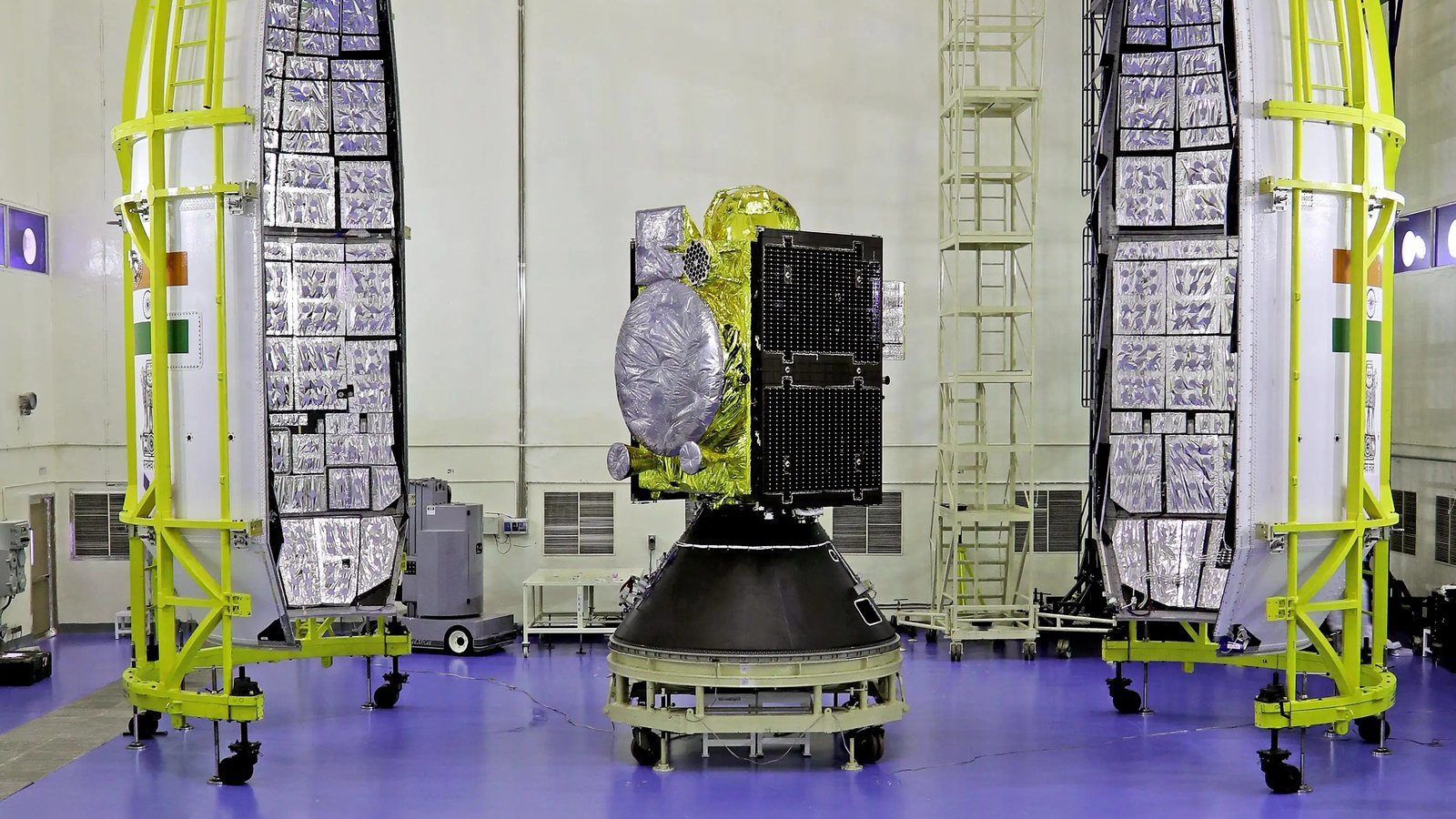
NVS-03 is India's next navigation satellite. The Indian Space Research Organisation (ISRO) built it for Navigation with Indian Constellation (NavIC), India's own version of the Global Positioning System (GPS). It is the third satellite in the second-generation NVS series. It is due to launch on the GSLV-F18 rocket from Sriharikota.
NavIC needs it because the system is short of working satellites. In July, the government told Parliament that only three NavIC satellites were giving positioning, navigation and timing services, India Today reported. A receiver needs signals from at least four satellites to work out where it is. So right now NavIC can't give a position on its own. Its timing service still works.
Status as of 26 October 2026: ISRO's Sriharikota launch centre lists the launch for 11:51 PM IST on Friday 30 October. Our GSLV-F18 launch time page has the latest.
What is NavIC?
NavIC used to be called the Indian Regional Navigation Satellite System (IRNSS). It is a regional system. GPS covers the whole world, but NavIC covers India and up to 1,500 km beyond its borders.
ISRO designed NavIC around seven satellites:
- Three in geostationary orbit. They stay over fixed points on the equator.
- Four in geosynchronous orbits tilted 29 degrees to the equator, two in each of two orbital planes.
NavIC offers two services. The Standard Positioning Service is for civilian users. The Restricted Service is for strategic users. ISRO's navigation services page says the signals are designed for position accuracy better than 20 metres and timing accuracy better than 50 nanoseconds.
Why is NavIC short of satellites?
Clocks are a big part of it. Every navigation satellite carries atomic clocks, and a position fix depends on precise time. According to The Indian Express, ISRO has launched 11 navigation satellites since July 2013, and six have failed. The paper reported that the main cause was faulty imported atomic clocks, plus orbit problems a few times.
Two recent losses made it worse:
- NVS-02 never reached its working orbit. It launched on GSLV-F15 on 29 January 2025, into a 170 x 37,785 km transfer orbit. Then its engine could not raise the orbit. ISRO's review found that the signal to open a valve on the engine's oxidiser line never arrived. The most likely cause was a loose connector.
- IRNSS-1F lost its clock. It launched in March 2016 and finished its 10-year design life on 10 March 2026. Three days later, its atomic clock stopped. ISRO says it now only sends one-way broadcast messages.
What is different about the NVS satellites?
NVS is the second generation of NavIC satellites. ISRO has not published a detailed spec sheet for NVS-03. So here is what it said about NVS-01, the first in the series, launched in May 2023:
- Size: about 2,232 kg at liftoff, built on ISRO's standard I-2K satellite body.
- Signals: navigation payloads in three bands, L1, L5 and S. L1 is new for NavIC. ISRO says L1 is popular for civilian services and works alongside other navigation systems.
- Clock: a rubidium atomic clock developed in India, at ISRO's Space Applications Centre in Ahmedabad.
- Life: a 12-year mission.
Our view: the home-grown clock is the change that matters most. But the NVS series still uses imported clocks too. ISRO's GSLV-F15/NVS-02 brochure says NVS-02 "uses a combination of indigenous and procured atomic clocks". ISRO hasn't said which clocks NVS-03 carries.
Will NVS-03 fix NavIC?
It should help, but it won't happen on launch day. NVS-03 is expected to restore NavIC's own positioning once it reaches its orbit and starts working, according to the report cited near the top of this article. The rocket only drops it in a transfer orbit, and the satellite has to raise its own orbit from there. NVS-02 shows that this step can fail.
More satellites are coming. The government has said NVS-04 and NVS-05 are in advanced stages of development.
Our view: getting back to four working satellites matters more than any single new feature. Four is the minimum for a position fix. Seven is the full design.
Does this affect my phone?
Probably not. Many phones also use GPS and other systems, so navigation on phones has not stopped. The government has also said users face no security or operational risk from the shortfall. NavIC matters most because India controls it, and for strategic users and timing.
When does NVS-03 launch?
NVS-03 is set to launch on a GSLV rocket at 11:51 PM India Standard Time (IST) on Friday 30 October 2026. That time is on the Launch View Gallery page of Satish Dhawan Space Centre (SDSC SHAR), ISRO's launch centre at Sriharikota. ISRO's main website hasn't posted it yet.
Follow it on our GSLV-F18 launch time page or the launch tracker. For how ISRO's year is going, see the 2026 launch scoreboard.