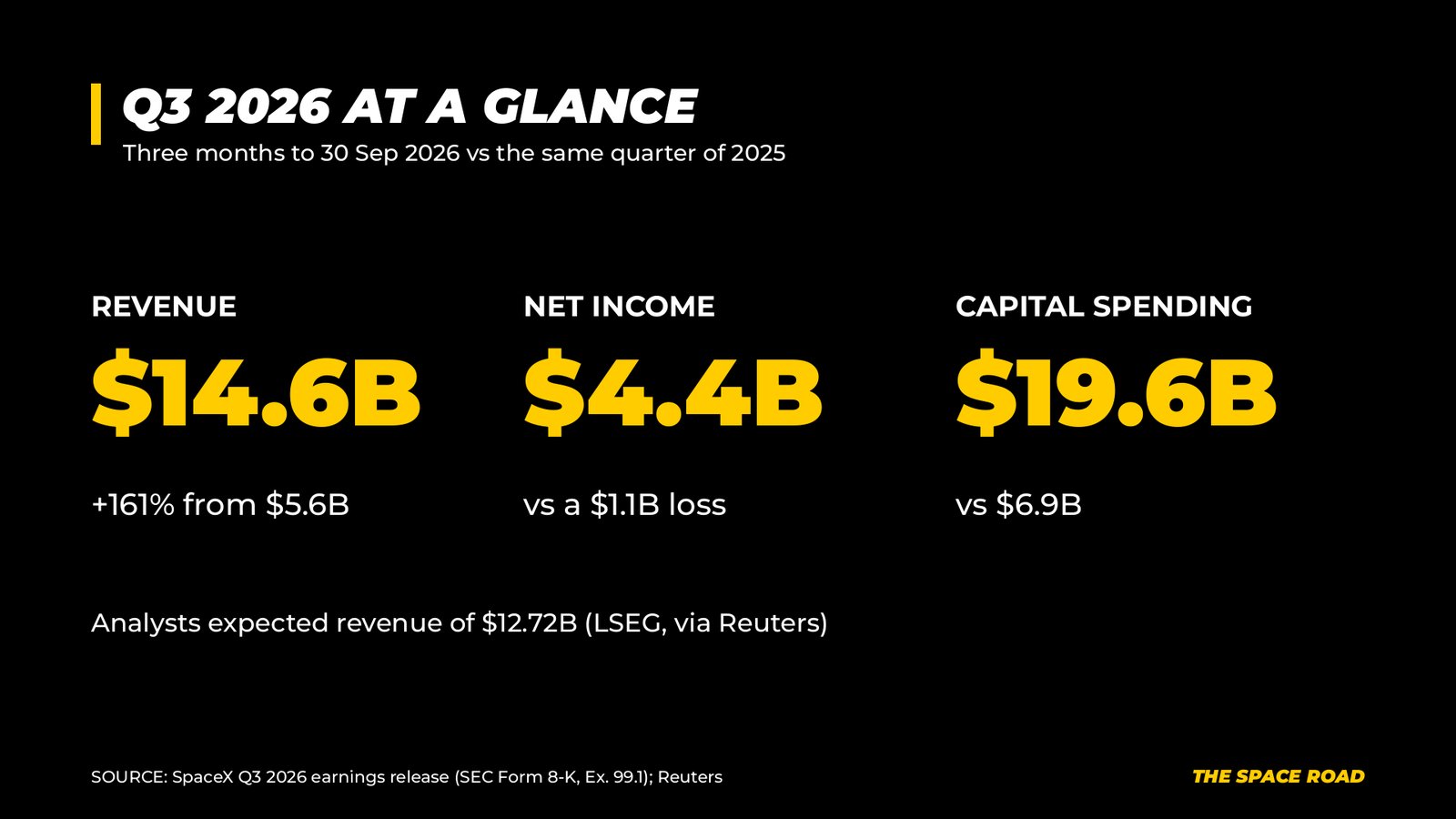


Starlink is SpaceX’s satellite internet service. Thousands of satellites in low Earth orbit (LEO) talk to a dish at your home, on a vehicle or on an aircraft, then route data through the constellation and, where needed, through ground gateways. SpaceX’s Q3 2026 results said the company had more than 11,100 broadband and mobile satellites in LEO as of 30 September 2026. An independent catalogue by astronomer Jonathan McDowell, updated 9 November 2026, listed 11,204 Starlink satellites still in orbit.
This page answers the questions people type most often. Prices and availability change by address, so treat retail numbers as a snapshot.
How does Starlink work?
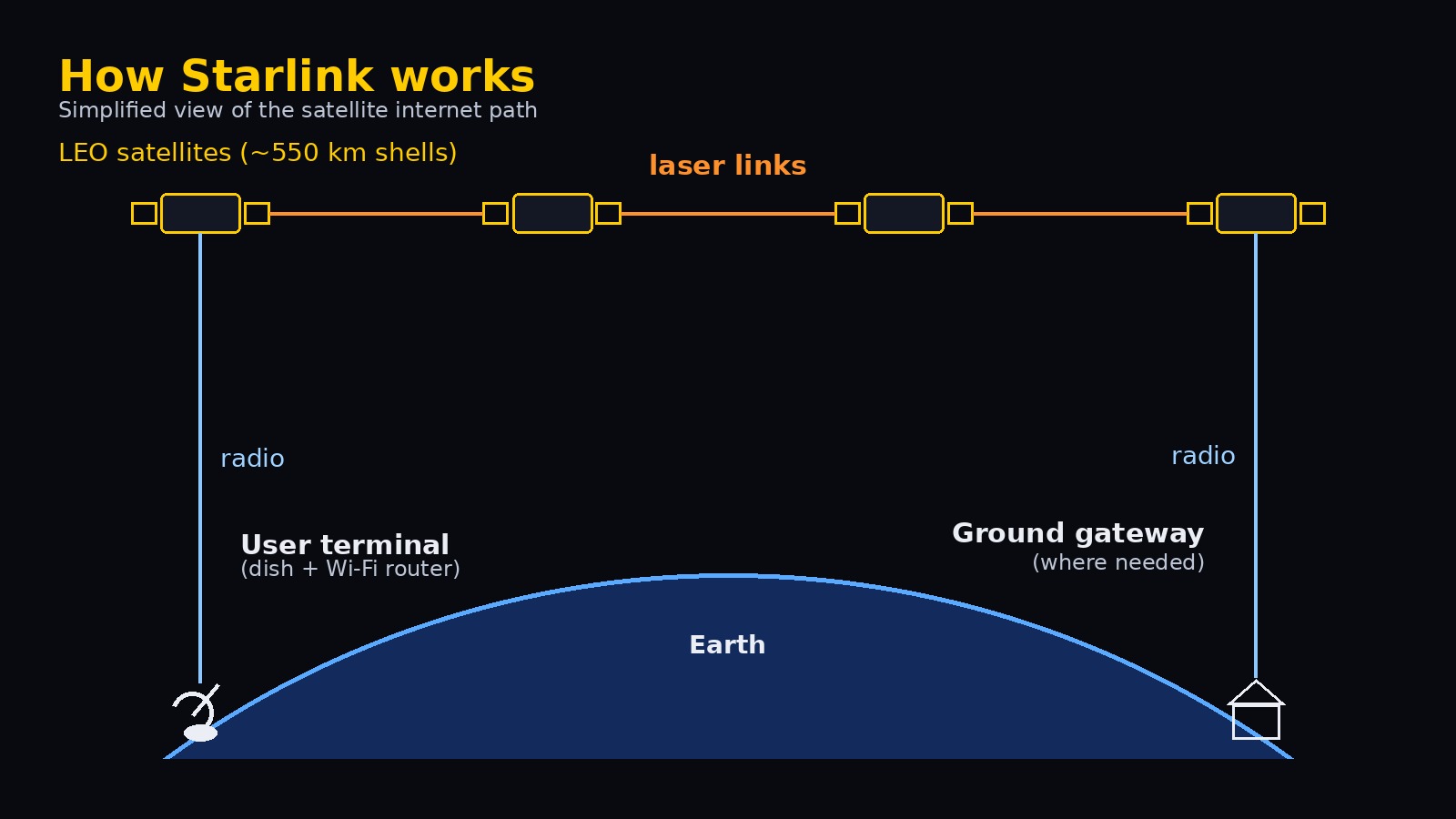
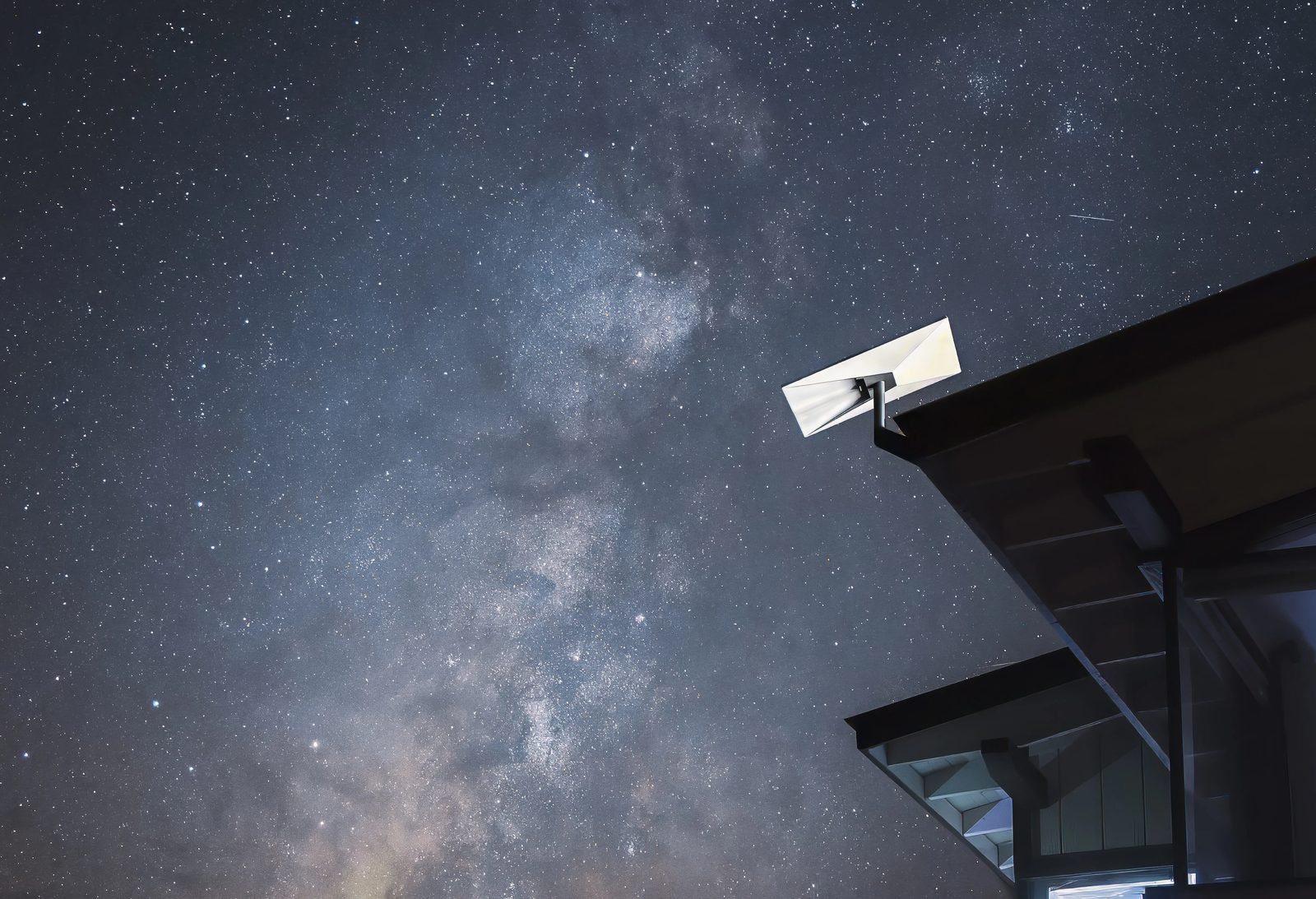
- User terminal. A flat phased-array dish outdoors points itself at satellites and connects to a Wi-Fi router indoors.
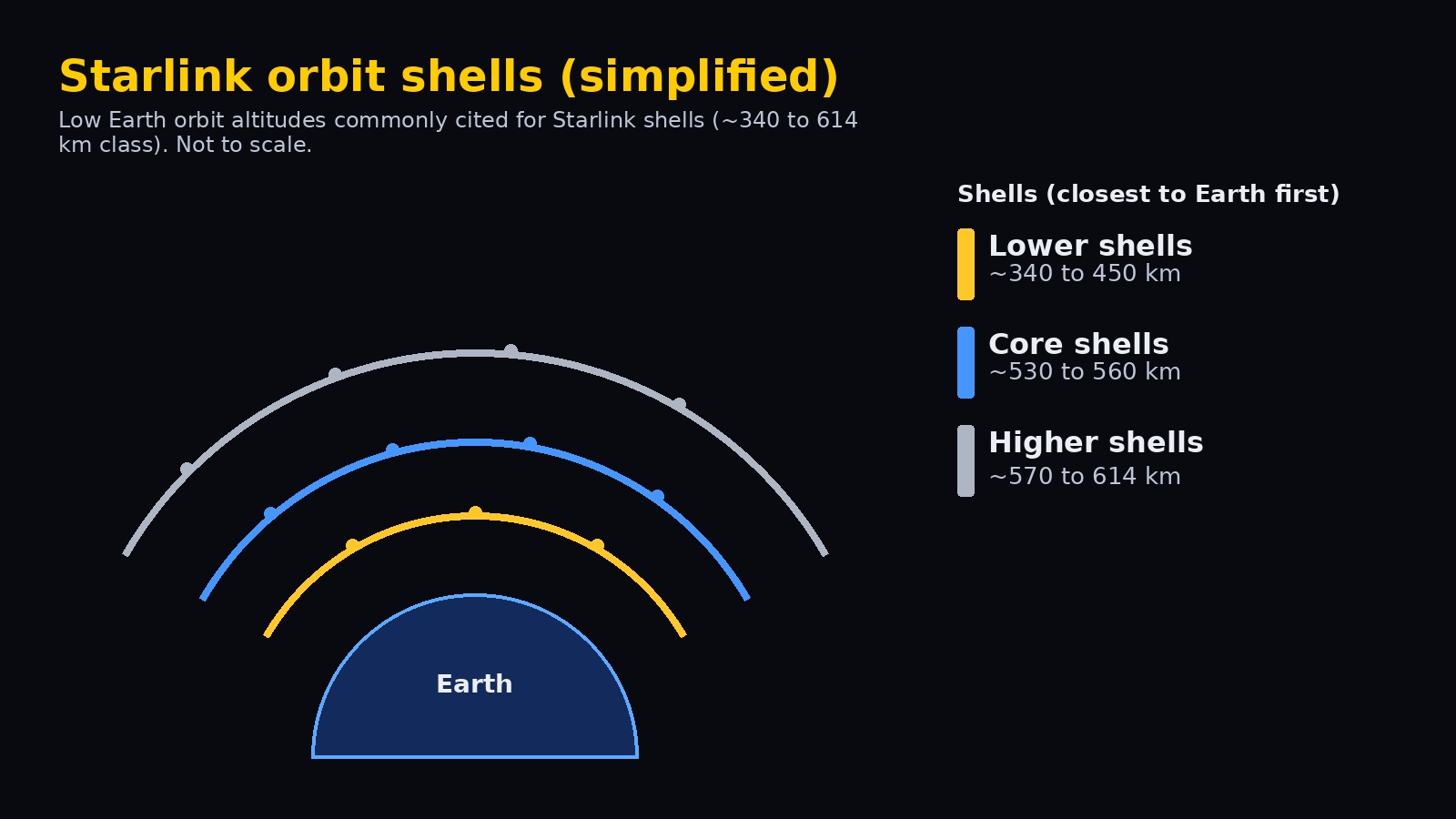
- LEO satellites. Spacecraft a few hundred kilometres up pass overhead often. Lower altitude means lower lag than traditional geostationary internet satellites.
- Laser links. Many Starlink satellites pass data to each other with lasers, so traffic can cross oceans without a nearby ground station.
- Gateways. Where the path needs the ground network, a gateway antenna connects the constellation to the terrestrial internet.
How many Starlink satellites are there?
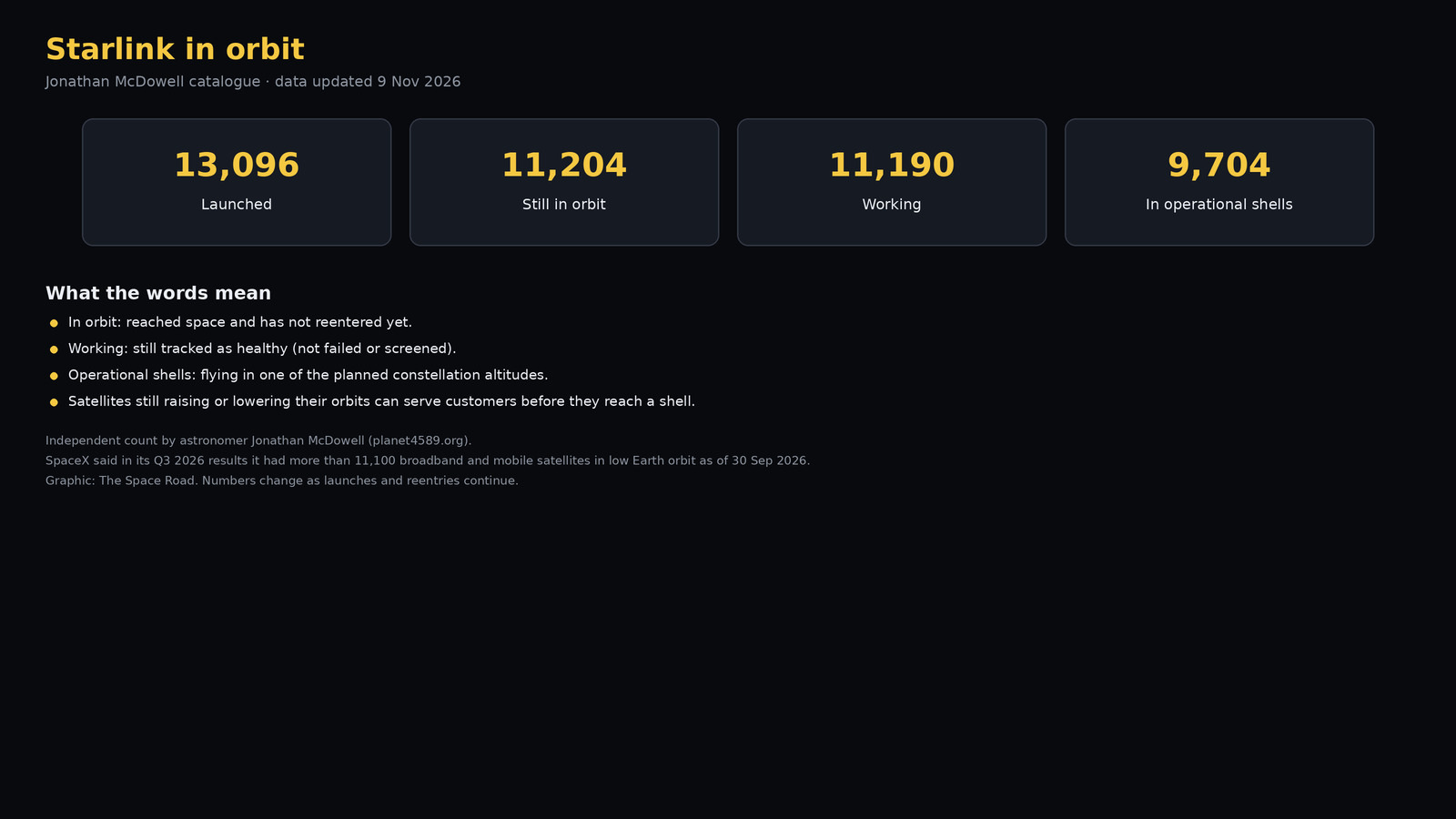
Use two figures, and keep the date:
| Source | Date | Figure |
|---|---|---|
| SpaceX Q3 2026 results | As of 30 Sep 2026 | More than 11,100 broadband and mobile satellites in LEO |
| Jonathan McDowell catalogue | Updated 9 Nov 2026 | 13,096 launched; 11,204 in orbit; 11,190 working; 9,704 in operational shells |
“In orbit” includes satellites still climbing or coming down. “Operational shell” means they sit in one of the planned constellation altitudes. McDowell notes that satellites outside those shells can still carry traffic.
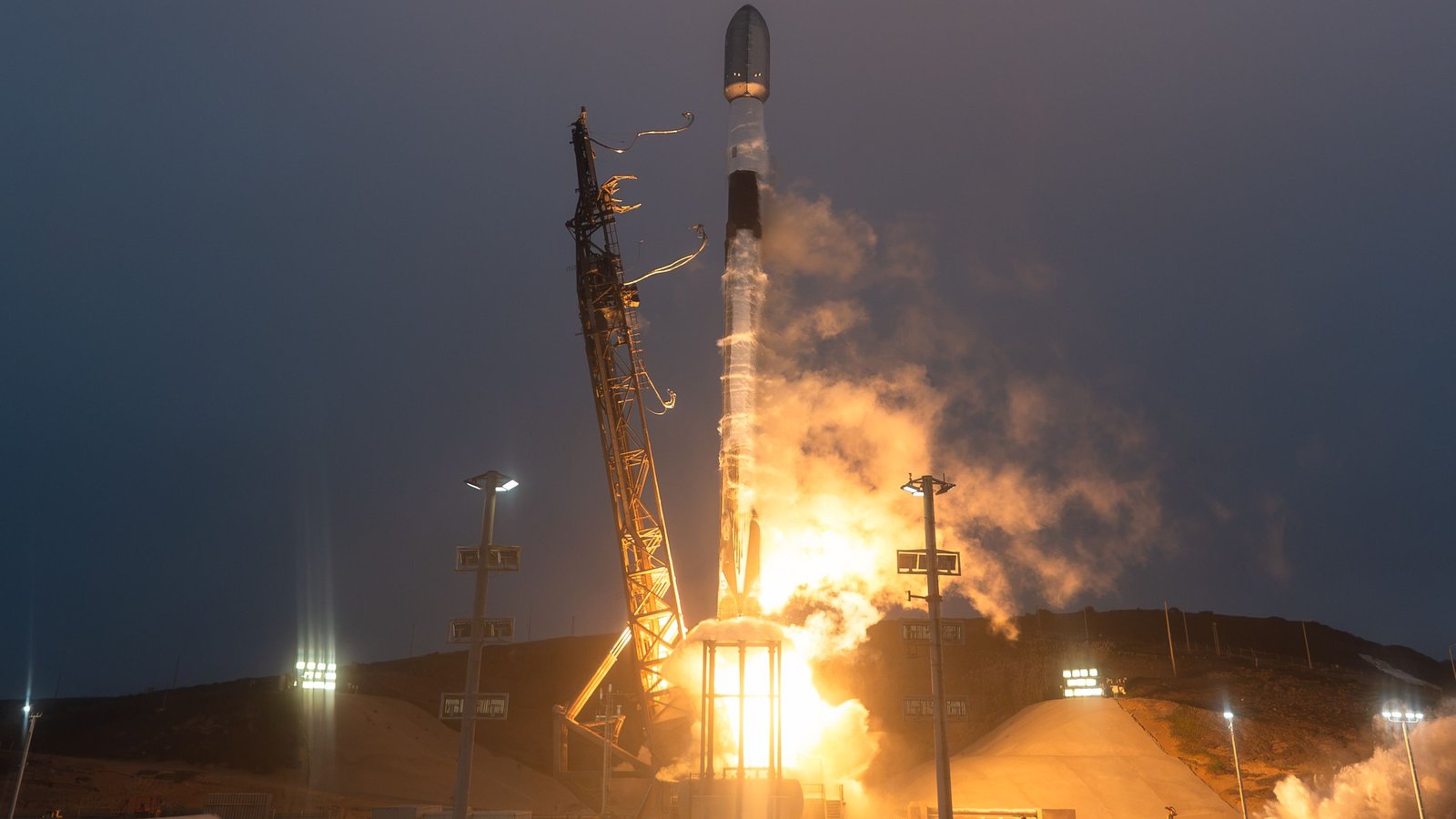
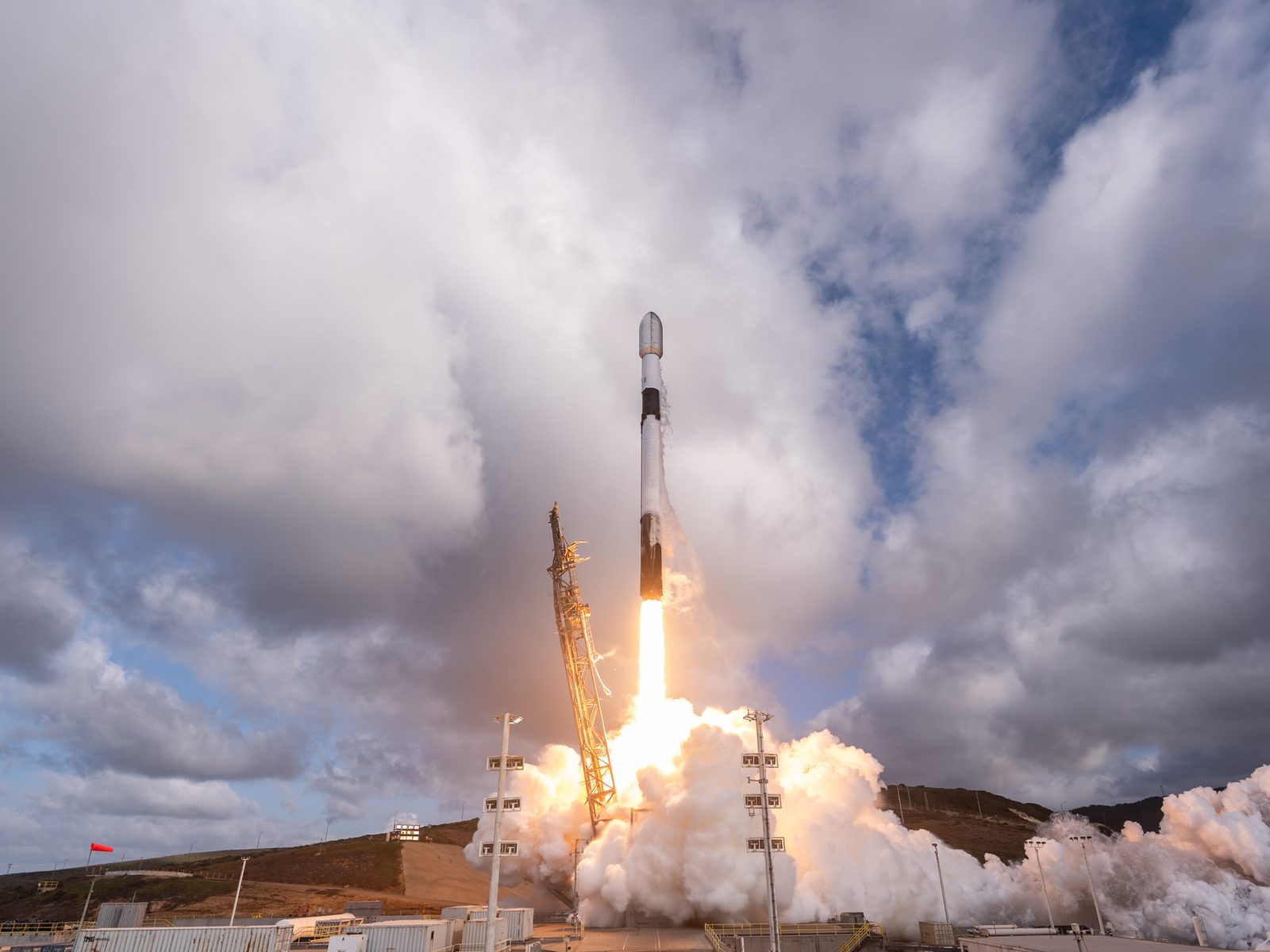
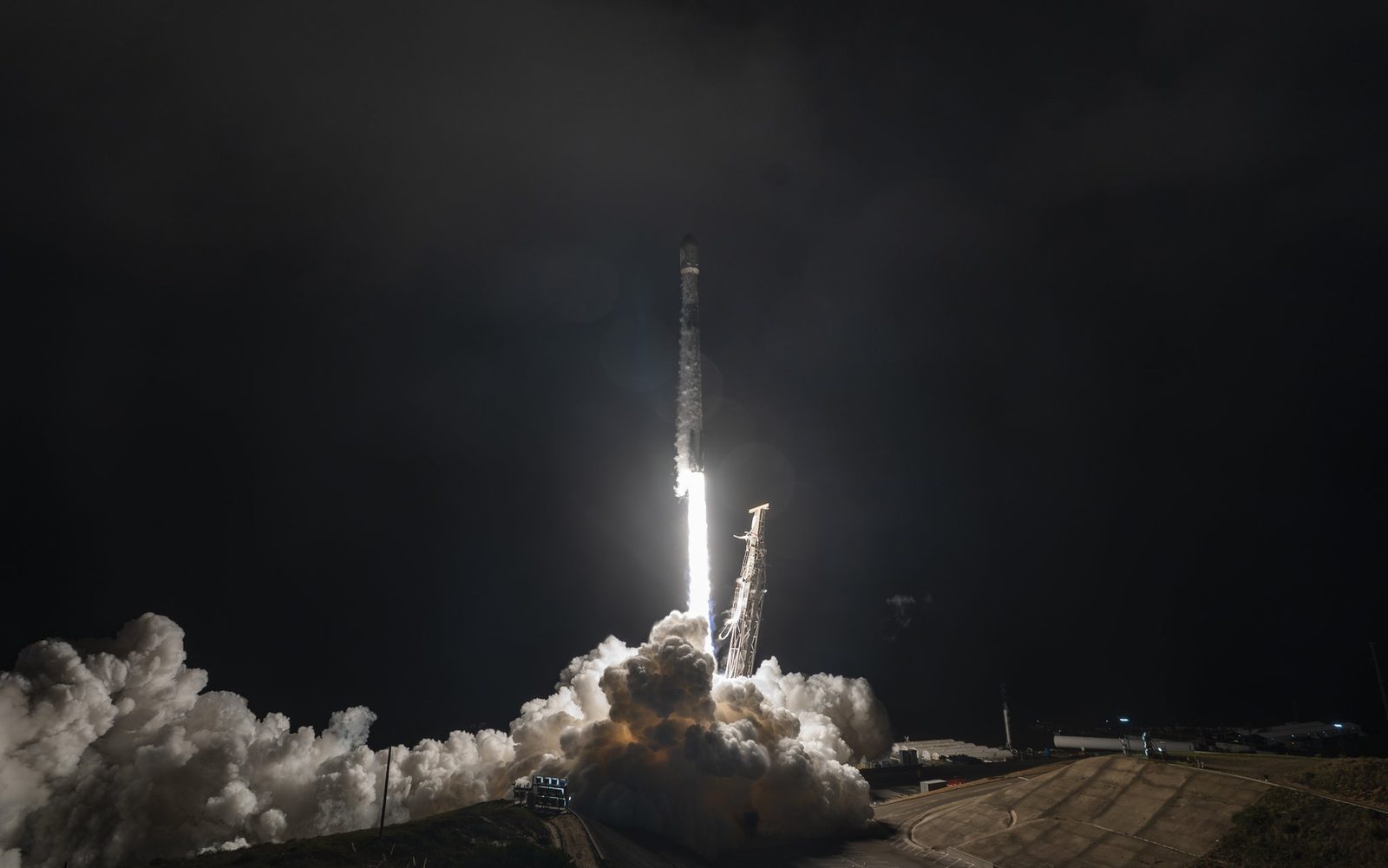
Falcon 9 still flies most Starlink batches. Starship Flight 15 is planned to deploy Starlink V3 satellites and attempt a dual catch. For the business side, see our SpaceX Q3 2026 earnings explainer.
How many customers, and where is Starlink available?
As of 30 September 2026, SpaceX’s Q3 2026 results said Starlink had 13.6 million consumer subscribers, up 1.6 million from the prior quarter, plus hundreds of thousands of additional enterprise subscribers. The same filing said Starlink had been activated across aviation partnerships on more than 3,800 aircraft.
On official Starlink pages checked on 9 November 2026, SpaceX describes availability as 150+ countries, territories and other markets on the Starlink availability map, and 160+ countries, territories and other markets on the Starlink homepage. Those are the figures to prefer. Secondary coverage of the Q3 earnings call (for example Fierce Network, October 2026) reported SpaceX describing service in 174 markets. That “174” number is call coverage, not a clearly labelled line in the SEC HTML exhibit we checked.
Availability still varies by address. Check the map on starlink.com/map for your location.
What are V2 Mini and V3?
Public SpaceX materials describe generations of Starlink spacecraft. V2 Mini satellites have been the workhorses on Falcon 9. V3 satellites are larger, higher-capacity craft designed for Starship. (More in Starlink V3 and how many Starlink satellites there are.) SpaceX has said each Starship V3 launch can add more than 20 times the capacity of a current Falcon V2 Mini launch. Exact on-orbit counts by generation change weekly; McDowell’s tables break launches down by group.
How fast is Starlink, and what does it cost?
On Starlink’s US residential page as checked on 9 November 2026, listed plans included:
- Residential 100 Mbps: $50 per month
- Residential 200 Mbps: $80 per month
- Residential Max: $120 per month
Starlink also states speeds up to 400+ Mbps in many places and more than 99.9% average uptime. Speeds, prices and hardware offers vary by country and address. Always check the official map for your location. This is not a price guarantee.
What is Starlink Direct to Cell (Starlink Mobile)?
Direct to Cell is Starlink’s service to ordinary mobile phones without a dish. The satellites act like cell towers in space and connect through mobile network partners.
Progress so far (company sources):
- SpaceX began launching Direct to Cell satellites in January 2024. Its 8 September 2025 update said more than 600 Direct to Cell satellites were in orbit and that the first-generation constellation was operational across five continents, connecting over six million users.
- Starlink’s 2025 Progress Report said the first-generation Direct to Cell constellation was complete with more than 650 satellites launched in about 18 months, that the service had connected more than 12 million people at least once, and that more than 6 million people monthly actively relied on it where terrestrial service was unavailable. Direct to Cell satellites fly around 360 km altitude.
- Named partner carriers on Starlink’s Direct to Cell page have included T-Mobile (USA), Optus and Telstra (Australia), Rogers (Canada), One NZ (New Zealand), KDDI (Japan), Salt (Switzerland), Entel (Chile and Peru) and Kyivstar (Ukraine), with more partnerships unannounced.
Spectrum and next generation:
- On 8 September 2025, EchoStar announced a deal to sell AWS-4 and H-block spectrum licenses to SpaceX for about $17 billion (up to $8.5 billion cash and up to $8.5 billion in SpaceX stock), plus about $2 billion of EchoStar debt interest support through November 2027. SpaceX said the spectrum would support a next-generation Direct to Cell constellation. Closing depends on regulatory approvals. SpaceX’s own update describes about 50 MHz of US S-band (AWS-4 and PCS-H) plus global MSS licenses, and says next-generation satellites aim for roughly 20x the throughput of a first-generation Direct to Cell satellite and more than 100x system capacity.
- FCC approval of the EchoStar/SpaceX spectrum path was widely reported in May 2026 (for example SpaceNews and Reuters). Final transfer timing can still depend on conditions and non-US approvals.
- SpaceX’s Q3 2026 results also noted a later agreement to acquire FCC licenses related to 800 MHz spectrum for the Starlink Mobile strategy, expected to close in the first half of 2027 subject to conditions. A SpaceX update dated 8 October 2026 described that low-band purchase and FCC approval for a Gen2 Starlink Mobile constellation application (authorizing up to 15,000 satellites optimized for 2 GHz globally).
Treat coverage and user counts as company statements, and check your local carrier for what is live on your phone.
Which airlines have Starlink Wi-Fi?
Starlink Aviation puts a terminal on the aircraft so passengers get high-speed, low-lag Wi-Fi. Many airlines make it free (often for loyalty members). SpaceX’s Q3 2026 results said more than 3,800 aircraft were equipped as of 30 September 2026. Starlink’s aviation page describes gate-to-gate connectivity on tens of thousands of flights.
Passengers like it because speeds are often high enough for video, cloud work and multiplayer games, and because many carriers do not charge a separate Wi-Fi fee.
Airlines with Starlink flying passengers (verified active examples)
These airlines have public statements that Starlink is already in passenger service on at least some aircraft. Rollouts are fleet-wide over time, so check your flight:
| Airline | What is live | Source / date |
|---|---|---|
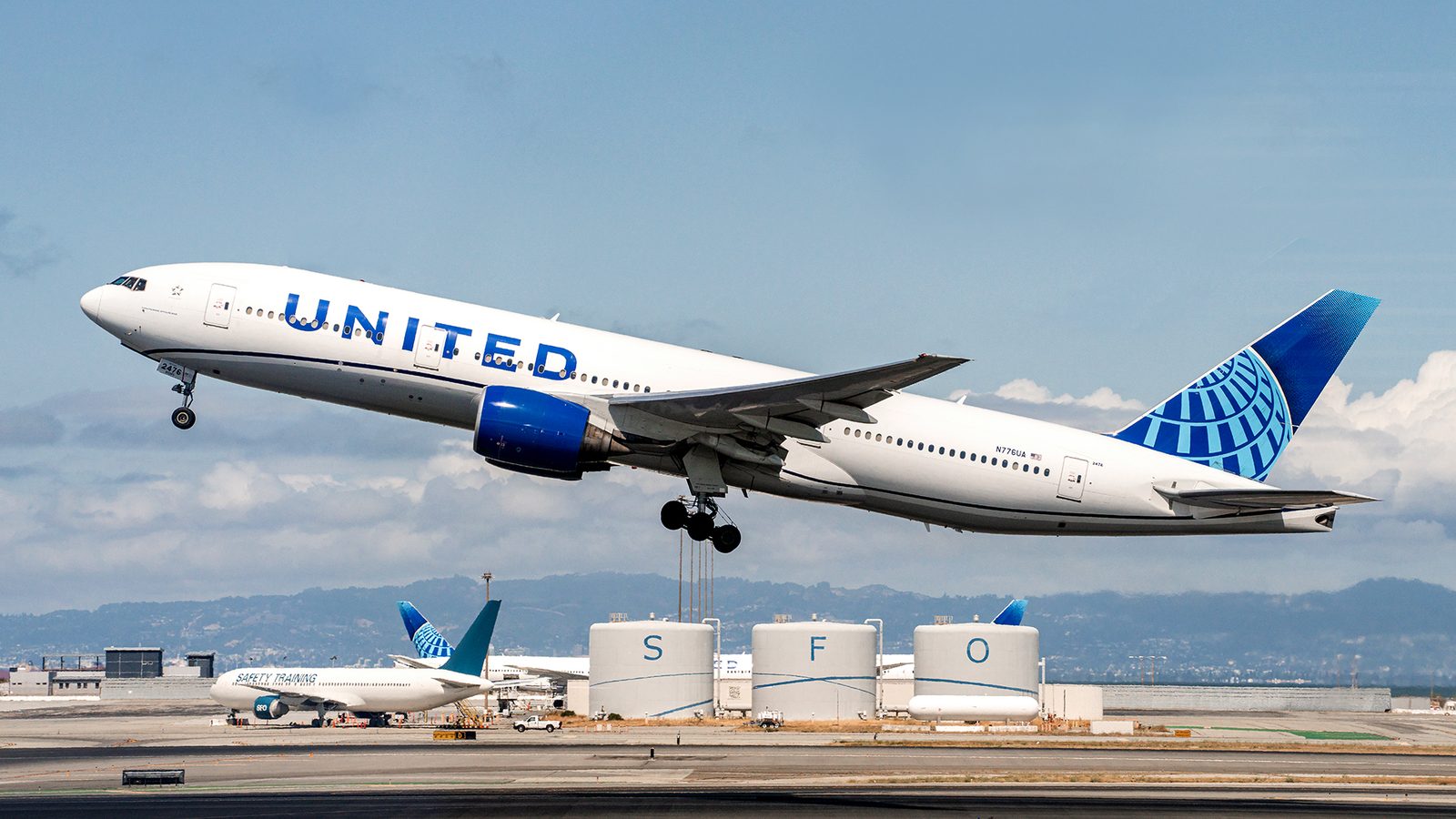
| United Airlines | More than 400 planes had Starlink as of 22 Jun 2026; free for MileagePlus members; widebody rollout underway | United newsroom, 22 Jun 2026 |
| SAS | All 81 Airbus A320neo aircraft equipped; free for EuroBonus members via partner 3 | SAS press release, 1 Sep 2026 |
| Brussels Airlines | First commercial Starlink flight SN2257 on 9 Nov 2026; free with Travel ID or Miles & More | Brussels Airlines press, 9 Nov 2026 |
| Qatar Airways | Starlink on B777, A350 and B787 aircraft on listed routes; free (Privilege Club for full-flight access) | Qatar Airways connectivity page (checked Nov 2026) |
Other airlines have announced Starlink or begun installs (for example parts of the Lufthansa Group beyond Brussels Airlines, and many more carriers tracked by aviation press). Announced-only deals are not listed above as “active.” Always confirm on the airline’s own site for your aircraft.
How does Starlink affect astronomy?
Large LEO constellations leave bright streaks on some telescope images and can raise radio-interference questions for observatories.
The US National Science Foundation (NSF) published a coordination agreement with SpaceX (updated 2022 provisions summarised 10 January 2023). Goals drawn from NOIRLab, AAS SATCON workshops and IAU Dark and Quiet Skies guidance include working toward about 7th visual magnitude or fainter, keeping orbital elevations near 700 km or lower, and publishing orbital information astronomers can use for scheduling. NSF’s NOIRLab is the optical/infrared contact; NSF’s National Radio Astronomy Observatory (NRAO) handles radio issues. SpaceX committed to dynamic coordination with key US radio facilities (including VLA, VLBA, Green Bank and others) beyond the baseline 10.6 to 10.7 GHz protection.
What SpaceX has tried optically (NSF summary and published photometry papers):
- DarkSat: a dark coating test. It raised thermal concerns and was not continued as the main path.
- VisorSat: sunshades that reduced brightness for a time; later dropped on designs that needed clear laser-comm paths.
- Later generations: dielectric mirror film to reflect sunlight away from Earth, solar-array mitigations, darker paints, and attitude practices (including “knife-edge” orientations during orbit raising).
Independent photometry still finds many satellites brighter than the V≈7 community target, so mitigation is progress, not a finished problem. Rubin Observatory and other survey telescopes remain a focus of the community debate.
How does Starlink handle space safety?
Starlink satellites use autonomous collision avoidance. SpaceX says it manoeuvres when the estimated collision probability is greater than 3 in 10 million, which is stricter than the common 1-in-10,000 industry threshold.
In its FCC semi-annual space-safety reporting covering 1 December 2025 to 31 May 2026 (filed around 1 July 2026 under SpaceX’s Gen 1 and Gen 2 reporting conditions), SpaceX reported about 65,137 propulsive manoeuvres for Gen 1 satellites and 142,015 for Gen 2 satellites in that six-month period (about 207,152 combined). We could not retrieve a stable public PDF URL from fcc.gov ECFS/IBFS or the ICFS portal in this pass, so the counts here follow secondary reporting that quotes the filing, including Space.com. Treat them as SpaceX’s self-reported filing numbers pending a direct FCC attachment link. The obligation to file those semi-annual manoeuvre counts is set out in SpaceX’s Gen 2 authorizations (for example FCC DA-26-36).
Other SpaceX/Starlink practices described on company pages:
- Deorbiting: failed or retiring satellites are designed to reenter from low altitude rather than linger.
- Open ephemerides: Starlink publishes operator ephemerides on space-track.org (Modified ITC format, roughly 72-hour predictions, updated several times daily) and mirrors them for operators.
- Stargaze / Space Safety platform: Starlink offers free ephemeris sharing and fast conjunction screening, and says Stargaze uses a large optical sensor network. Company posts ask other operators to share their own trajectories as well.
Quick answers
How many Starlink satellites are there? About 11,200 still in orbit as of early November 2026 on McDowell’s catalogue; SpaceX reported more than 11,100 broadband and mobile satellites in LEO at 30 September 2026.
How many customers? 13.6 million consumer subscribers as of 30 September 2026, per SpaceX’s Q3 results, plus enterprise users.
Is Starlink on airplanes? Yes. SpaceX reported more than 3,800 aircraft equipped as of 30 September 2026. United, SAS, Qatar Airways and Brussels Airlines are among carriers with verified passenger service on at least part of their fleets.
How does Starlink work? A dish (or phone, for Direct to Cell) talks to LEO satellites; satellites relay by laser and radio; gateways connect to the ground internet where needed.
Who owns Starlink? SpaceX.
For launches that fill the constellation, use our launches tracker. For Starship’s role carrying V3 satellites, see What is Starship?.