
Amazon Leo is Amazon's satellite internet network. Its satellites circle Earth in low Earth orbit and send internet to small antennas on the ground. Until November 2025 it was called Project Kuiper.
The next big step is its first ride on Vulcan, the newest rocket from United Launch Alliance (ULA). The mission, called LV-01 (Leo Vulcan 1), targets 12:54 p.m. Eastern Standard Time (EST) on Friday 13 November 2026, ULA says. It will carry 40 satellites from Cape Canaveral, Florida. Amazon says the launch is pending range approval, the final OK from the people who run the launch area.
Follow every launch on our launch schedule, and see what else is flying in this week's launches.
What is Amazon Leo?
Amazon Leo is a constellation, a large group of satellites working together. Amazon says the network has three parts:
- Satellites: they fly in low Earth orbit and pass data between users and the ground network.
- Ground stations: large gateway antennas link the satellites to the internet, to cloud services and to private networks.
- Customer antennas: small terminals that people and businesses use to connect.
Amazon says Leo's satellites will orbit between 590 and 630 km above Earth. Low Earth orbit is any orbit up to about 2,000 km. Being close to Earth means less delay, or latency, than older satellite internet, so video calls and gaming work better, Amazon says.
The name is a nod to that low Earth orbit. Amazon started the project under the code name Project Kuiper and retired it on 13 November 2025.
How many Amazon Leo satellites are there?
Amazon says its first constellation design has more than 3,000 satellites.
Full-scale launches began in April 2025. Amazon's mission list shows 14 missions before LV-01, carrying 396 satellites in total. Amazon describes this as "nearly 400" and says it makes Leo the third-largest constellation in orbit.
Building them is moving fast too. Amazon finished its 1,000th satellite in early September 2026. Its factory in Kirkland, Washington, can build up to five satellites a day, the company says.
For comparison, SpaceX's network is far bigger. See what Starlink is and how many Starlink satellites are in orbit.
Which rockets launch Amazon Leo?
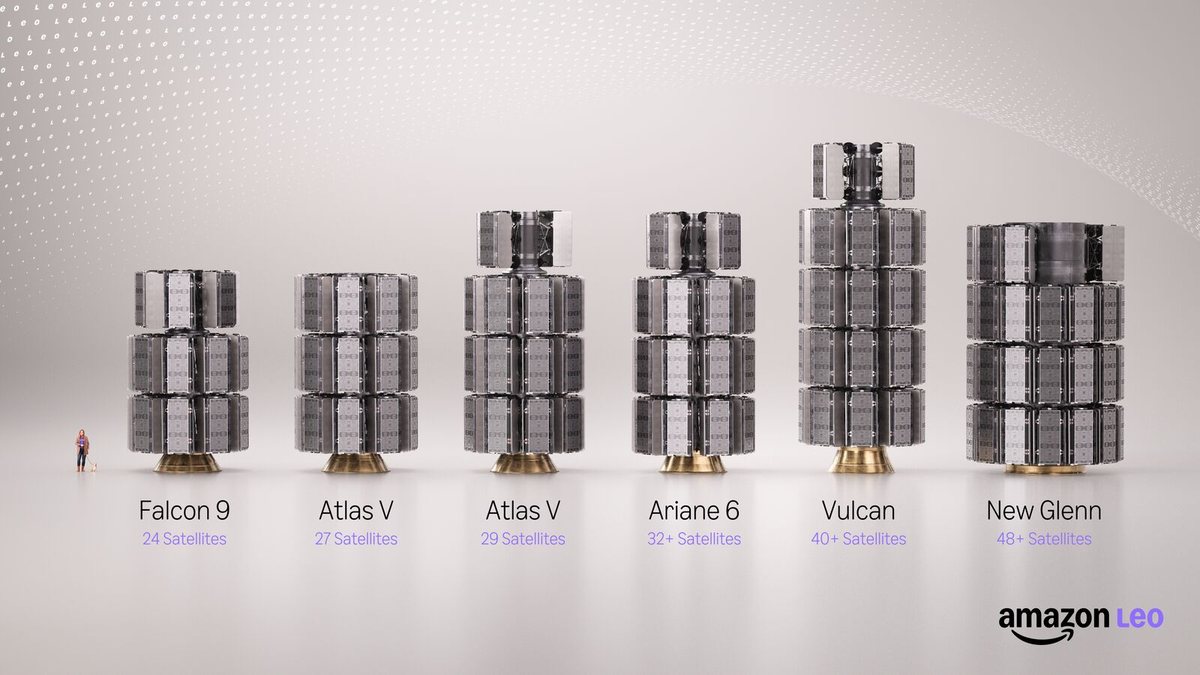
Amazon uses several launch companies on purpose, so it can keep launching as new rockets come online. Its launch partners are:
- ULA: Atlas V flew eight Leo missions. Vulcan now takes over, with 38 launches on contract.
- Arianespace: Ariane 6 has flown three Leo missions so far. Amazon raised its Ariane 6 contract from 18 to 24 launches in September 2026.
- SpaceX: Falcon 9 flew three missions with 24 satellites each in 2025.
- Blue Origin: New Glenn is also on the list. Amazon's graphic shows it carrying 48 or more satellites per launch. Read what happened to New Glenn for its recent history.
Amazon says its launch manifest now holds more than 100 missions. It says Vulcan will launch more than 1,500 first-generation satellites across its 38 missions, more than any other rocket in the program.
What is the LV-01 mission?
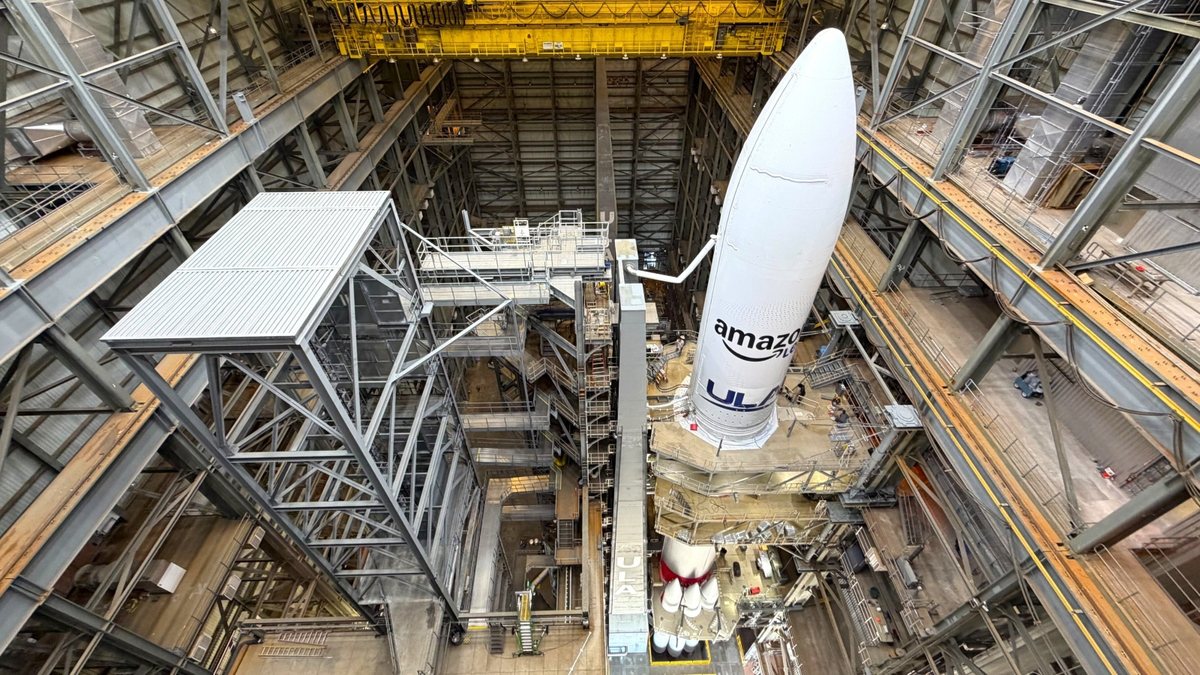
LV-01 is Amazon Leo's first launch on Vulcan and the biggest Leo payload yet. Here are the key facts from ULA and Amazon:
- Launch time: 12:54 p.m. EST, Friday 13 November 2026, pending range approval.
- Launch site: Space Launch Complex 41 (SLC-41), Cape Canaveral Space Force Station, Florida.
- Satellites: 40, the largest batch Amazon Leo has sent up at once.
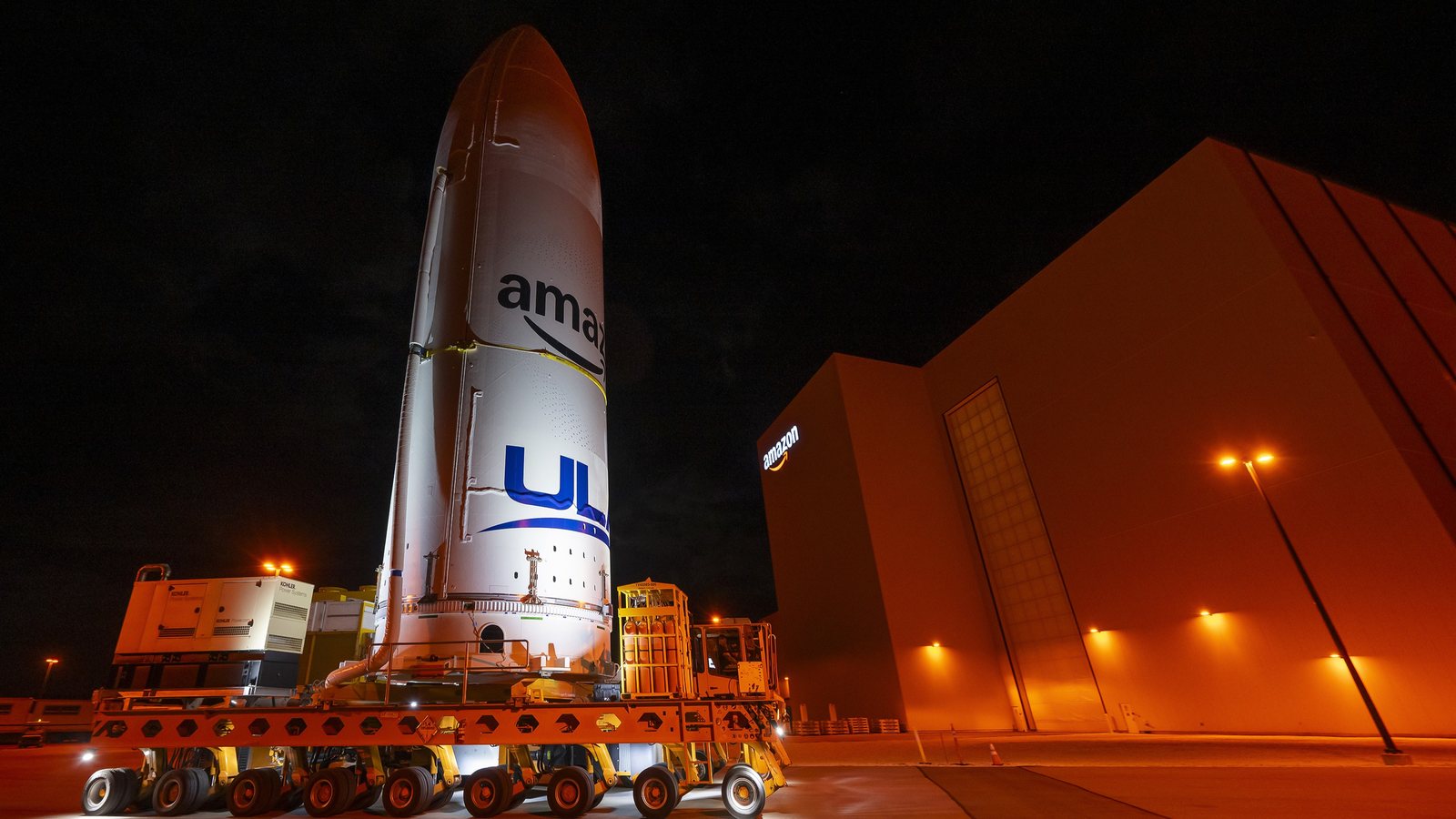
- Rocket: Vulcan VC6L, its most powerful version, with six solid rocket boosters strapped to the sides.
- Upper stage: a shorter Centaur V built for low Earth orbit, flying for the first time. It burns liquid hydrogen and liquid oxygen in two RL10 engines.
- Main stage: two BE-4 engines, built by Blue Origin, burning liquefied natural gas and liquid oxygen.
- Fairing: 5.4 m wide and 21.3 m long, the long version of Vulcan's nose cone.
Amazon says it is also the first Vulcan mission to fly with six boosters. The boosters use an improved nozzle design, and testing and analysis will continue alongside the mission.
Why does the Vulcan launch matter for Amazon Leo?
Bigger rockets and more launches are how Amazon fills its network. "Vulcan will launch close to half our first-generation constellation, making it our primary workhorse over the next several years," said Melissa Wuerl, director of launch systems for Amazon Leo.
Amazon also paid for new ground equipment at the Cape. LV-01 is the first mission to use a dedicated assembly building, called VIF-A, and a new mobile launch platform. The fully stacked rocket rides by rail about 4.3 km to the pad, ULA says. With two buildings, ULA can prepare two Vulcans at once. Amazon says LV-02 is already being prepared and could launch within weeks of a normal LV-01 flight.
When can people use Amazon Leo?
Not everyone yet. Amazon began an enterprise preview in November 2025, letting selected business customers test the network. In its 9 November 2026 update, Amazon said it expects an initial service rollout later this year, followed by wider service as more satellites launch.
Amazon has announced three customer antennas:
- Leo Nano: a 7 by 7 inch (about 18 cm) antenna, with download speeds up to 100 megabits per second (Mbps).
- Leo Pro: an 11 by 11 inch (about 28 cm) antenna, with download speeds up to 400 Mbps.
- Leo Ultra: a business antenna, with download speeds up to 1 gigabit per second (Gbps) and upload speeds up to 400 Mbps.
What comes after LV-01?
Amazon's next listed mission after LV-01 is LE-04 (Leo Europe 4). It is set to carry 36 satellites on an Ariane 6 from Kourou, French Guiana, no earlier than 23 November 2026. Ariane 6 will release them at about 465 km, and Amazon will then raise them to their working height of 630 km, the company says.
Want to compare launch providers? Our guide to who else is landing rockets covers the companies racing SpaceX on reuse.